Zola vs The Knot: Which Wedding Website Is Better for RSVPs?
Zola vs The Knot compared for engaged couples: wedding websites, RSVP and guest list tools, meal choices, plus-ones, designs, pricing, ads and privacy, plus when a simpler RSVP-first option makes more sense.
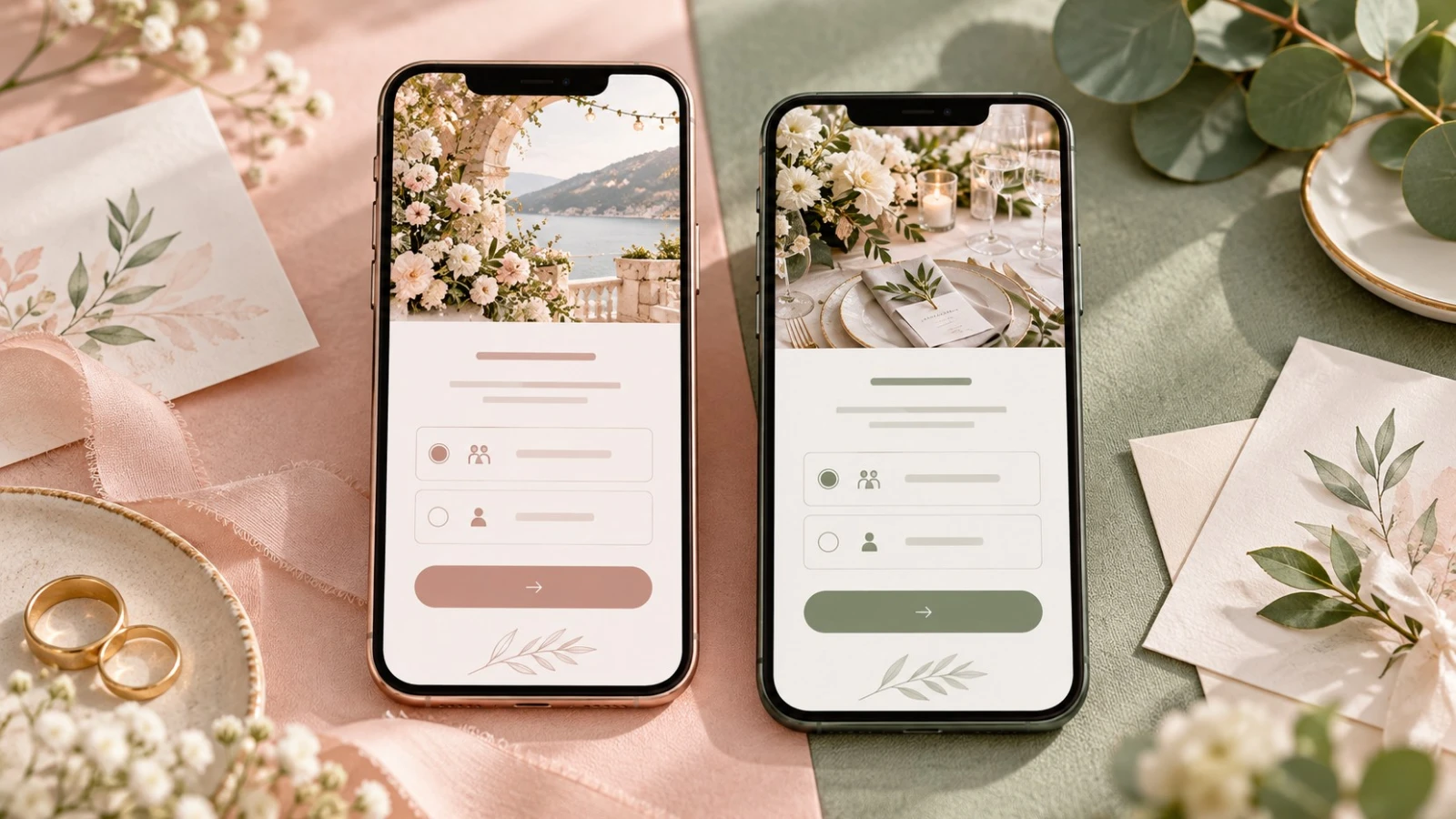
Choosing between Zola and The Knot can feel like one more complicated decision on an already crowded wedding planning checklist. Both offer free wedding websites, online RSVPs, guest list management, registries, and attractive designs. But when it comes to actually collecting responses, tracking meal choices, managing plus-ones, and making things easy for guests, which one works better? This Zola vs The Knot comparison breaks down the differences for couples planning a wedding, including when a simpler RSVP-focused alternative might make more sense.
Zola vs The Knot: Quick Comparison
Zola and The Knot are two of the most recognizable wedding planning platforms in the United States. Both can handle the essential tasks of creating a wedding website, sharing event details, and collecting guest responses without charging for their core website features.
The main difference is how each platform fits into your overall wedding planning experience.
Zola emphasizes an integrated planning experience, connecting your wedding website, registry, guest list, RSVPs, seating chart, and other planning tools.
The Knot offers a similarly comprehensive platform, with a strong focus on wedding inspiration, vendor discovery, planning resources, registries, and customizable wedding websites.
Neither platform is automatically better for every couple. The right choice depends on whether you want a complete planning ecosystem or simply an easy way for guests to respond.
Wedding website cost: Zola: Free. The Knot: Free.
Online RSVP collection: Zola: Yes. The Knot: Yes.
Guest list management: Zola: Yes. The Knot: Yes.
Meal selections: Zola: Yes. The Knot: Yes, through custom questions.
Plus-one management: Zola: Yes. The Knot: Yes.
Multiple wedding events: Zola: Supported. The Knot: Supported.
Website templates: Zola: 600+ advertised designs. The Knot: 100+ advertised designs.
Wedding registry: Zola: Integrated registry. The Knot: Integrated and external registries.
Guest mobile access: Zola: Mobile-friendly website. The Knot: Mobile-friendly website.
Guest app required: Zola: No. The Knot: No.
Custom domain: Zola: Optional paid feature. The Knot: Optional paid feature.
Website privacy: Zola: Password protection available. The Knot: RSVP access controls available.
Planning tools: Zola: Registry, seating, guest management. The Knot: Vendors, planning, guest management.
Best suited for: Zola: Couples wanting connected planning tools. The Knot: Couples wanting websites and broader wedding planning resources.
Both platforms are capable of managing a typical wedding guest list. The differences become more noticeable when you start configuring RSVPs, designing your website, and deciding how much of your planning process you want inside one service.
Zola Wedding Website: Features, Benefits, and Limitations
Zola combines wedding website creation with tools for managing the practical details of a wedding.
Its website builder lets couples select a template, add their names and wedding date, upload photographs, share venue information, and create an RSVP page.
Guests can visit the website to find directions, check the schedule, browse the registry, and submit their attendance responses.
What Zola does well
One of Zola's biggest strengths is the connection between its wedding planning features.
For example, when a guest responds to an invitation, that information can flow into your guest management process rather than requiring you to maintain a separate spreadsheet.
Zola also supports multiple wedding events, making it useful for couples organizing a rehearsal dinner, ceremony, reception, or other celebrations with different invitation lists.
Other useful features include:
Wedding website templates covering traditional, modern, floral, and minimalist styles.
Guest list management and online RSVP tracking.
Meal preference collection and invitation-specific guest access.
Registry integration and gift management.
Password protection for wedding websites.
Planning tools that connect RSVPs with seating arrangements.
These features make Zola particularly appealing when you want your registry, website, and guest information connected.
Where Zola may feel complicated
Zola's broader functionality can also create unnecessary setup work for couples with simpler needs.
If your main goal is to send guests a link, collect attendance responses, and download or review your guest information, you may not need the surrounding registry and planning features.
Some couples may also prefer a service that does not encourage them to explore additional wedding products.
This is not a problem unique to Zola. Comprehensive wedding platforms naturally contain more features than a dedicated RSVP tool.
For a closer look at its guest response system, read the guide to using Zola wedding website RSVPs.
The Knot Wedding Website: Features, Benefits, and Limitations
The Knot is another established wedding planning platform with free wedding websites and RSVP functionality.
Its website builder allows couples to choose a design, add event information, upload photos, create frequently asked questions, and connect their gift registries.
The Knot also provides planning resources and vendor discovery tools, which can be useful if you're still researching photographers, venues, florists, or other wedding services.
What The Knot does well
The Knot's main advantage is its combination of website creation and broader wedding planning resources.
Couples can create a website that shares important details while also using the platform for guest management and planning activities.
Its RSVP tools support custom questions, allowing couples to collect information beyond a simple yes-or-no response.
For example, you can ask guests to select an entrée or provide dietary restrictions.
Other useful features include:
Free customizable wedding websites.
RSVP tracking connected to a guest list manager.
Custom RSVP questions.
Guest messaging and reminder templates.
Wedding registry links.
Matching stationery designs for many templates.
Planning resources and vendor discovery.
The Knot can be especially useful for couples who want their wedding website to match printed invitations and other stationery.
Where The Knot may feel complicated
The Knot offers many services beyond website creation.
For some couples, having vendor listings, registries, planning resources, and website tools together is convenient. Others may find the experience more extensive than necessary.
The Knot's RSVP configuration also requires attention to guest list settings, particularly when deciding whether anyone with the website link can respond or only guests already on your list.
If you're considering the platform mainly for collecting attendance, the comparison of a dedicated wedding RSVP website versus The Knot explores that narrower decision.
Zola vs The Knot for Wedding RSVPs
For many couples, RSVP management is the most important feature of a wedding website.
An attractive design is helpful, but accurate guest counts, meal selections, and clear attendance records directly affect catering, seating, and venue planning.
Both Zola and The Knot support online RSVPs, although their configuration and guest management workflows differ.
RSVP setup and guest list management
Zola connects RSVP responses to its wedding guest list and other planning tools.
You can prepare your invitation list, organize guests, and collect responses for different wedding events. Its guest management system is particularly useful when some guests are invited to additional celebrations.
The Knot also connects online RSVPs to its Guest List Manager.
Couples can configure private RSVPs for invited guests or allow broader responses through public RSVP settings.
This flexibility is useful, but it is important to understand the difference.
A private RSVP system helps prevent uninvited guests from adding themselves to your attendance list. A public system may be easier to share widely, but it requires more attention to incoming responses.
The practical takeaway: Both platforms can handle a conventional wedding guest list. The best option is the one whose guest management process feels easiest to maintain.
Meal choices and dietary restrictions
Both platforms allow couples to collect food-related information during the RSVP process.
Zola supports meal preferences through its wedding RSVP tools.
The Knot allows couples to configure meal selections using custom RSVP questions, including multiple-choice options.
Suppose your caterer offers chicken, salmon, and vegetarian entrées.
Your RSVP form should let guests identify their preferred meal and communicate any allergies or dietary restrictions.
For weddings with multiple guests per invitation, make sure the system captures the correct meal information for each person rather than just one answer for an entire household.
It is also worth confirming how responses appear in your guest management dashboard before you begin collecting them.
For help deciding which questions matter, see what to ask on a wedding RSVP form.
Plus-ones and household invitations
Plus-one management is another important consideration.
Both Zola and The Knot support guest list workflows that distinguish invited guests from additional attendees.
This matters because a couple might invite one person individually, another person with a named partner, and a family with children.
Without clear invitation settings, guests may assume they can bring additional people.
Before sharing your website, test several scenarios:
A guest invited alone.
A guest allowed to bring one additional person.
A couple invited together.
A family with children.
A guest invited to the reception but not a smaller pre-wedding event.
Your goal is to ensure that guests understand exactly who is included in their invitation.
RSVP reminders and deadlines
Collecting RSVPs is only part of the process. You also need a plan for guests who do not respond.
Zola provides guest messaging and reminder functionality connected to its planning tools.
The Knot provides guest messaging tools and reminder templates. Its documented workflow supports manually sending reminders rather than relying on automatic deadline reminders.
Regardless of platform, establish an RSVP deadline that leaves enough time to finalize your caterer and seating arrangements.
For many weddings, a deadline approximately three to four weeks before the event is a reasonable starting point, although your venue and vendors may require an earlier final count.
The wedding RSVP deadline best practices guide explains how to choose a deadline and handle late responses.
Wedding Website Designs and Customization
Design is one of the most visible differences in the Zola vs The Knot comparison.
Both platforms offer professionally designed templates, but their collections and customization experiences are not identical.
Zola website templates
Zola advertises more than 600 wedding website templates, covering styles such as classic, modern, rustic, floral, and minimalist.
This broad selection can be useful for couples who have a specific wedding aesthetic in mind.
You can customize your website with event information, photographs, and other details.
However, having hundreds of templates does not necessarily mean every element can be freely redesigned.
It is important to distinguish between choosing a design and having complete control over the website's layout.
The Knot website templates
The Knot advertises more than 100 wedding website designs.
Its collection includes traditional and contemporary styles, with many designs coordinating with wedding stationery.
This can be particularly appealing if you want your save-the-dates, invitations, and website to share a consistent visual theme.
As with Zola, the amount of customization depends on the selected template and available editing controls.
Which has better designs?
There is no universal winner.
Zola offers a larger advertised template collection, while The Knot emphasizes coordinated wedding stationery and website designs.
The best approach is to preview several templates on both desktop and mobile before committing.
Pay particular attention to the RSVP page itself. Guests should be able to find the response form without searching through multiple pages.
A beautiful website is less useful if guests cannot easily figure out how to respond.
Mobile Experience: Which Is Easier for Wedding Guests?
Most wedding guests will open your RSVP link on a smartphone.
They may receive it through a text message, email, QR code, or printed invitation.
Fortunately, both Zola and The Knot offer mobile-friendly wedding websites. Guests can open the website in their phone's browser without installing a dedicated app.
That is different from the experience for couples, who may choose to use the platforms' planning apps.
For guests, the important questions are straightforward: Can they find the RSVP form? Can they respond quickly? Can they enter their meal choices without confusion?
What makes a good mobile RSVP experience?
A well-designed mobile RSVP page should have readable text, clearly labeled buttons, simple questions, and an obvious confirmation after submission.
Avoid making guests navigate through unnecessary information before reaching the form.
This is particularly important for older relatives who may be less comfortable with online forms.
Before sending invitations, open your website on an iPhone and an Android phone if possible. Complete a test RSVP as though you were a guest.
For mobile RSVPs, neither Zola nor The Knot has a decisive advantage based on its advertised features. Both support browser-based responses, and the experience will depend partly on how you configure your website.
Zola vs The Knot Pricing: Are They Really Free?
Both Zola and The Knot offer free wedding websites with core RSVP functionality.
You do not need to purchase a subscription just to create a basic wedding website and collect responses.
Optional purchases are where costs can enter the picture.
Zola pricing
Zola's standard wedding website is free, including its essential RSVP and guest management features.
Optional costs may include a custom domain, stationery, and other wedding-related purchases.
Its registry and shopping services are separate from the basic website creation process.
The Knot pricing
The Knot also provides its core wedding website and RSVP features for free.
A personalized domain is optional, and couples can use a free website address instead.
Additional spending may come from stationery, vendor bookings, or other wedding services rather than the basic RSVP functionality.
What about advertisements and upsells?
Both platforms operate within larger wedding businesses.
Zola includes registry, gift, and stationery services. The Knot includes vendor discovery, registries, stationery, and other planning resources.
This means couples may encounter product recommendations, promotional content, or opportunities to purchase related services while using the platforms.
That does not mean guests will necessarily see intrusive advertisements on the couple's actual RSVP page.
The distinction matters: promotional content within a planning dashboard is not the same as advertising displayed to wedding guests.
If avoiding unnecessary features or sales prompts is important, a standalone RSVP builder may offer a more focused experience.
Wedding Website Privacy and Guest Information
Wedding websites often contain personal details, including names, event locations, schedules, and guest information.
Both Zola and The Knot provide privacy controls, but couples should review their settings before publishing.
Zola offers password protection for wedding websites and guest-specific RSVP management.
The Knot also supports password protection and allows couples to control whether their website appears in search engine results. Its RSVP settings can restrict responses to invited guests.
Remember that password protection and search visibility are different things.
A website hidden from search engines may still be accessible to anyone with its direct link. A password-protected website requires visitors to enter the password before viewing protected details.
For either platform, avoid publishing information you would not want shared beyond your invited guests.
Also review what guest information is collected, who can access it, and how it can be managed after the wedding.
Ease of Use: Which Platform Takes Less Work?
Both platforms are designed for couples without web development experience.
You can choose a template, enter your wedding details, configure RSVPs, and share your website without writing code.
However, ease of use depends on what you need to accomplish.
If you want a complete wedding planning hub, Zola's connected registry, guest list, and seating tools can reduce the need to manage information across multiple services.
If you want a wedding website alongside vendor research, planning resources, and stationery options, The Knot offers a convenient collection of tools.
But if you already have your venue, vendors, invitations, and registry organized, setting up a full wedding planning platform may be unnecessary.
A simpler RSVP-only website can help you avoid spending time configuring features you will never use.
SnapRSVP: A Simpler Alternative for Wedding RSVPs
Not every couple needs an all-in-one wedding planning platform.
Some couples already have their registry, venue information, and planning process handled. What they still need is a clean website where guests can confirm attendance.
That is where SnapRSVP offers a different approach.
SnapRSVP focuses on creating an easy-to-share RSVP website rather than replacing your entire wedding planning process.
Couples can create a wedding RSVP website, share its link or QR code, and collect responses online.
Guests can respond from any smartphone without downloading an app.
SnapRSVP supports attendance tracking, meal choices, plus-ones, dietary information, and customizable RSVP settings.
Its pricing is also straightforward: $19.99 as a one-time payment, with no subscription.
Unlike Zola and The Knot, SnapRSVP is not intended to be a comprehensive wedding registry or vendor marketplace.
That distinction is important. Zola and The Knot provide free core RSVP tools and more extensive planning features. SnapRSVP charges a one-time fee for a more focused RSVP experience.
Couples who prefer that approach can explore the SnapRSVP pricing and features.
For more detailed comparisons, see the Zola alternative for wedding RSVPs, The Knot alternative for RSVP websites, and the comparison of wedding RSVP websites and Zola.
Which Should You Choose?
The best wedding website depends on what matters most to you.
Choose Zola if you want connected wedding planning tools
Zola is a strong choice when you want your wedding website, registry, guest list, seating arrangements, and RSVP information connected.
It is particularly appealing for couples who prefer to manage multiple planning tasks through one platform.
Its extensive template collection is another advantage if design variety matters.
Choose The Knot if you want wedding planning resources and a website together
The Knot makes sense if you want a free wedding website alongside vendor discovery, registry tools, stationery designs, and planning resources.
Its guest management and RSVP features are capable of handling traditional wedding invitations, meal questions, and attendance tracking.
Couples already using The Knot for other planning tasks may find it convenient to keep everything together.
Choose SnapRSVP if you mainly need straightforward RSVP tracking
SnapRSVP is worth considering if your priority is collecting guest responses through a simple, mobile-friendly website.
It is particularly relevant for couples who do not need an integrated registry, vendor marketplace, or extensive planning dashboard.
The one-time payment may be worthwhile for couples who value a focused experience, although Zola and The Knot remain excellent free options.
If you're still comparing services, explore these wedding RSVP alternatives before making your decision.
Frequently Asked Questions About Zola vs The Knot
Is Zola better than The Knot?
Zola is not universally better than The Knot. Both offer free wedding websites and online RSVP tracking. Zola may be preferable if you want integrated registry, seating, and guest management tools. The Knot may be more appealing if you also want vendor discovery, planning resources, and coordinated stationery. For basic wedding RSVPs, both are capable choices.
Is Zola or The Knot better for RSVPs?
Both platforms support attendance tracking, guest lists, meal questions, and plus-one management. Zola connects RSVPs closely with its broader planning tools, while The Knot offers customizable RSVP questions and flexible guest list settings. The best choice depends on your event complexity and which interface you find easier to use.
Can I use Zola and The Knot together?
Yes. You can use Zola for one part of your planning and The Knot for another. For example, you might use one service for a registry and the other for your wedding website.
However, avoid collecting RSVPs through both platforms unless you have a clear process for reconciling responses. Maintaining two separate attendance lists can create confusion and duplicate work.
Are Zola and The Knot wedding websites completely free?
Both offer free wedding websites with core RSVP functionality. You can create a website and collect guest responses without paying for a subscription. Optional purchases, such as custom domains or printed stationery, may cost extra.
Do guests need an app to RSVP on Zola or The Knot?
No. Guests can open either platform's wedding website in a mobile browser and submit their responses without installing an app. Couples may use planning apps for convenience, but those apps are not required for guests to respond online.
Can I switch from Zola to The Knot or another RSVP website?
Yes, but switching requires some planning. You may need to recreate your website, configure your guest list, and transfer existing RSVP information manually or through available export and import features.
Before switching, preserve your existing guest responses and verify which information your new platform can accept.
If invitations have already been sent, communicate the new RSVP link clearly to avoid guests submitting responses in different places.
Final Verdict: Zola vs The Knot
Zola and The Knot are both solid choices for creating a free wedding website.
Zola stands out for its connected wedding planning tools and extensive template selection. The Knot offers a strong combination of wedding websites, guest management, vendor discovery, and planning resources.
For most couples, neither is a bad choice.
The bigger question is whether you need a complete wedding planning platform or simply a reliable way to collect RSVPs.
If you mainly want guests to confirm attendance, choose meals, and respond from their phones without downloading an app, a dedicated RSVP website may be all you need.
Ready to simplify your wedding RSVPs? Create your wedding RSVP website with SnapRSVP for a one-time $19.99 payment, with no subscription, and give your guests an easy way to respond.